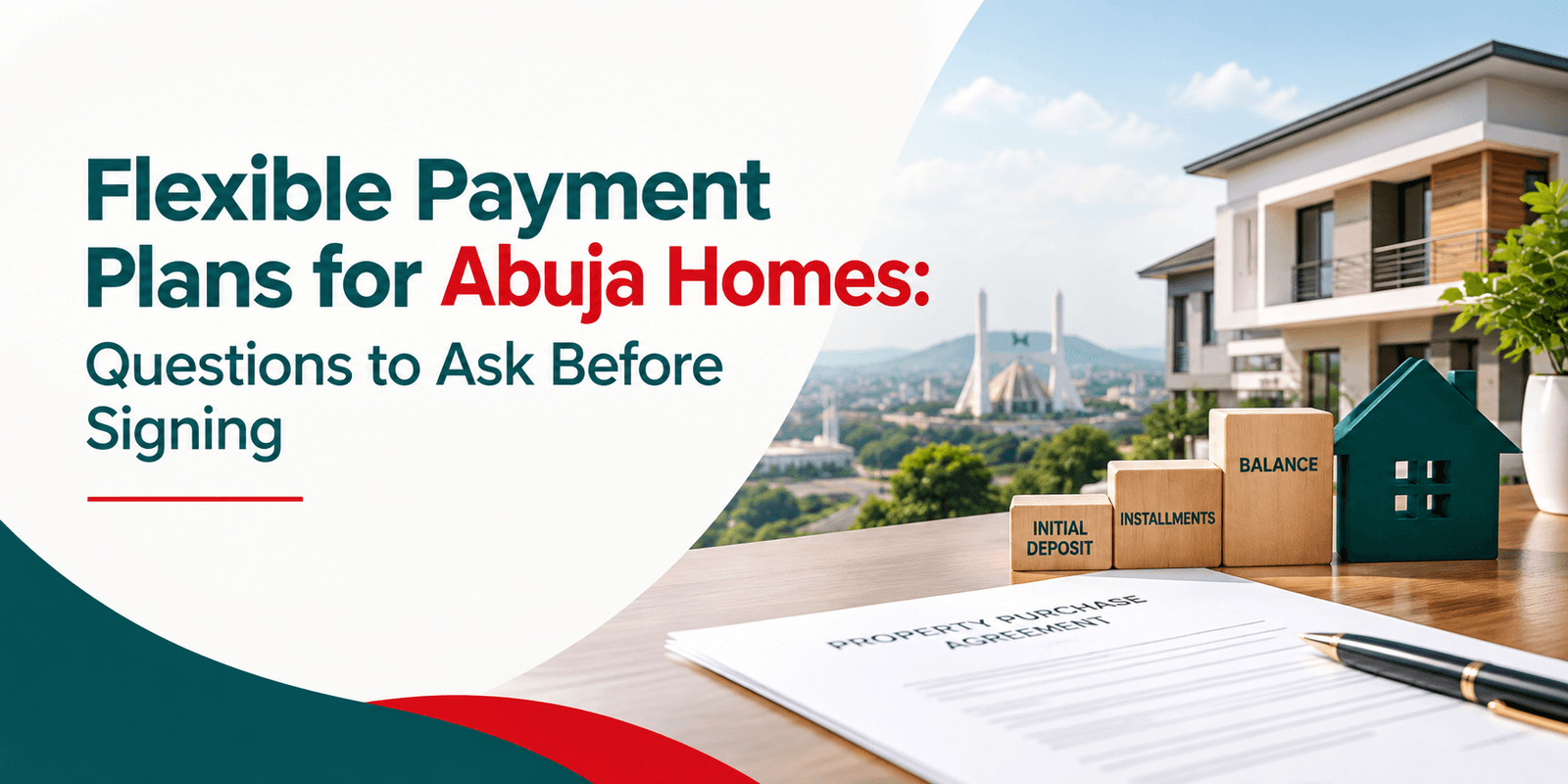
Flexible payment plans have made homeownership in Abuja far more accessible — you put down an initial deposit, typically somewhere between 10% and 40%, then spread the balance over months or years instead of raising the full sum upfront. But the flexibility that makes these plans attractive is also where the risk sits. Nigeria’s Federal Competition and Consumer Protection Commission (FCCPC) recently sealed off an estate in Life Camp Extension after buyers paid in full and never received their units, which is a reminder that the contract you sign matters more than the brochure you were shown.
Here are the seven questions to ask before you commit.
1. What Is the Total Cost — Not Just the Monthly Figure?
The advertised price and the amount you’ll actually part with are rarely the same number.
Ask for a full written cost breakdown covering:
- The base property price under the payment plan (often higher than the outright cash price, since spreading payments is a form of financing)
- Any interest or financing charge, and whether the plan is genuinely interest-free
- Legal and documentation fees
- Survey and deed of assignment costs
- Title processing or C-of-O charges
- Infrastructure or development levies
- Any agency or administrative fee
The question to ask: “What is the all-in figure I will have paid on the day I receive my keys and my title document?” Get that number in writing. Comparing two plans on monthly instalment alone is how buyers end up paying significantly more than they budgeted.
2. Does the Contract Contain an Escalation Clause?
This is one of the most commonly overlooked clauses in flexible payment plans for Abuja homes. An escalation clause allows the developer to increase the property price mid-plan — usually justified by inflation, exchange rate movement, or rising building material costs.
What to check:
- Is there an escalation clause at all? If so, ask for it to be pointed out and read it yourself.
- Is the increase capped at a specific percentage, or open-ended?
- How much notice must the developer give before applying it?
- Can it be applied more than once during your payment period?
- Does it apply to your remaining balance only, or retroactively to the whole price?
The question to ask: “Can the price I’m agreeing to today legally increase before I finish paying, and if so, by how much at most?” An uncapped escalation clause effectively means you’re signing a contract with no fixed price. If the developer insists on one, push for a hard percentage ceiling written into the agreement.
3. What Are the Refund Terms If You Cancel or the Project Fails?
Life happens — jobs change, circumstances shift, and sometimes projects stall. You need to know the exit terms before you need them.
What to clarify in writing:
- What percentage of payments made is refundable if you withdraw voluntarily?
- Is there an administrative or cancellation deduction, and what is it?
- How long does the refund take to process — 30 days, 90 days, or “when the unit is resold”?
- Is the refund in naira at the original amount, with no adjustment for time or inflation?
- What happens if the developer fails to deliver? Is there a full refund, and is interest or compensation payable?
The question to ask: “If I cancel in month eight, what exact amount comes back to me and in what timeframe?” Be wary of clauses that tie your refund to the developer reselling your unit, since that can leave your money tied up indefinitely.
4. What Is the Title Status of the Land?
This is the single most important question on the list, and it is not one to take the developer’s word on.
Verify independently:
- Does the land have a valid Certificate of Occupancy (C-of-O) or Right of Occupancy?
- Is the title registered and confirmable at the Abuja Geographic Information Systems (AGIS)?
- Is the land free of encumbrances, duplicate allocations, or government acquisition?
- Has the developer obtained layout approval and the necessary building permits?
- Does the intended use match the land’s official land-use designation?
Do the AGIS check yourself, or through your own lawyer — never rely solely on documentation handed to you by the seller’s marketing team. With the FCTA’s ongoing master plan review tightening compliance enforcement, title quality now affects both your legal security and your property’s resale value.
The question to ask: “What is the title number, and may I verify it at AGIS before I make any payment?” A legitimate developer will have no problem with this.
5. How Are Service Charges Set, and Can They Change?
Service charges are an ongoing cost that many buyers only think about after moving in, and in serviced estates they can be substantial.
What to establish before signing:
- What is the current service charge, and is it monthly, quarterly, or annual?
- What exactly does it cover — security, estate maintenance, waste, water, generator/diesel, common-area power?
- Who sets the rate: the developer, a facility manager, or a residents’ association?
- How often can it be reviewed, and is there a cap on increases?
- Is there a separate sinking fund for major repairs, and who holds it?
- Do you pay service charges during the construction period, or only after handover?
The question to ask: “What is the current annual service charge per unit, and who has the power to increase it?” An estate where the developer retains permanent unilateral control over service charges is worth thinking carefully about.
6. What Construction Milestones Trigger Each Payment?
In a well-structured off-plan payment plan, your money is released against visible progress — not just against dates on a calendar.
What the contract should specify:
- A payment schedule tied to defined construction stages (foundation, decking, roofing, plastering, finishing, handover)
- The expected completion date, with a clearly defined grace period
- A detailed schedule of finishes, materials, and architectural dimensions attached as an addendum
- A clause stating that material changes to the building plan require your written consent
- Your right to inspect the site at reasonable intervals
Attaching a specification addendum is important protection: without it, a developer can quietly substitute lower-grade finishes than you were shown in the showroom, and you’d have little contractual ground to object.
The question to ask: “Which construction milestone does each of my payments correspond to, and what happens to my schedule if construction falls behind?”
7. What Happens If You Default — and What If the Developer Does?
A fair contract holds both sides accountable. Many don’t.
On your side, clarify:
- How many days late before a payment is considered in default?
- Is there a grace period, and is it in writing?
- What is the late payment penalty, and how is it calculated?
- At what point can the developer terminate the agreement entirely?
- If terminated, do you forfeit everything paid, or a defined percentage?
- Can you restructure the plan if your circumstances change?
On the developer’s side, ask:
- What compensation applies if delivery is delayed beyond the grace period?
- Is there a penalty or interest payout to you, mirroring the one you’d pay for late payment?
If a developer demands a penalty for your late payments but offers nothing for their own late delivery, that’s an imbalanced contract — and it’s reasonable to negotiate a reciprocal clause.
The question to ask: “If I miss a payment, what do I lose — and if you deliver a year late, what do I get?”
Quick Reference: The Seven Questions
| # | Area | The Core Question |
|---|---|---|
| 1 | Total cost | What’s the all-in figure at handover, including all fees? |
| 2 | Escalation | Can the price rise mid-plan, and is the increase capped? |
| 3 | Refunds | What comes back to me if I cancel, and how fast? |
| 4 | Title status | What’s the title number, and can I verify it at AGIS first? |
| 5 | Service charges | What’s the current rate, and who can increase it? |
| 6 | Milestones | Which construction stage does each payment match? |
| 7 | Default | What do I lose if I’m late — and what do you owe if you are? |
Before You Sign: A Short Checklist
- Get every promise in writing; verbal assurances from sales agents aren’t enforceable.
- Have an independent property lawyer — yours, not the developer’s — review the contract.
- Verify the title at AGIS yourself before any payment leaves your account.
- Pay into a corporate account belonging to the named developer, never a personal account.
- Keep receipts and written confirmation for every single payment.
- Research the developer’s track record on previously delivered projects.
- Make sure the payment schedule genuinely fits your income, with room for the unexpected.
This article is general information, not legal or financial advice. Contract terms vary significantly between developers, and you should have any agreement reviewed by a qualified property lawyer before signing.
Frequently Asked Questions
What is a flexible payment plan for a home in Abuja? It’s an arrangement where a buyer pays an initial deposit — commonly between 10% and 40% of the price — and spreads the remaining balance over an agreed period through monthly, quarterly, or milestone-based instalments, rather than paying the full amount upfront.
Are flexible payment plans more expensive than paying outright? Often, yes. Properties bought on instalment are frequently priced higher than the outright cash price, because spreading payments functions as a form of financing, and some plans also carry explicit interest or financing charges.
What is an escalation clause in an Abuja property contract? It’s a clause allowing the developer to increase the agreed price during your payment period, typically citing inflation or rising construction costs. Buyers should check whether any escalation is capped at a fixed percentage rather than left open-ended.
Can I get a refund if I stop paying for an off-plan property in Abuja? It depends entirely on the contract. Some agreements refund a percentage after deductions, others impose significant forfeiture, and some tie refunds to the unit being resold — which is why refund terms should be read carefully before signing.
How do I verify a property’s title before signing a payment plan? Verify it independently at the Abuja Geographic Information Systems (AGIS), which is the official source of land records in the FCT, rather than relying only on documents provided by the seller or their marketing team.
What happens if I default on an Abuja home payment plan? Consequences vary by contract and can range from late-payment penalties to full termination and forfeiture of sums already paid, so it’s essential to confirm the grace period, penalty structure, and termination threshold in writing before committing.
Ready to Take the Next Step?
→ Browse off-plan properties: houseunlimitednigeria.com/off-plan-properties
→ Browse completed properties: houseunlimitednigeria.com/completed-properties
→ WhatsApp advisory team: +234 904 375 2708
→ Book free consultation: official@houseunlimitednigeria.com