
Title Security Essentials: Why C of O Remains King Over R of O in Abuja 2026
In Abuja’s fast-rising property market, choosing between Certificate of Occupancy (C of O) and Right of Occupancy (R of O) can make or break your investment. Here’s why C of O is still the gold standard for bank loans, demolition protection, and long-term security.
1/30/20263 min read
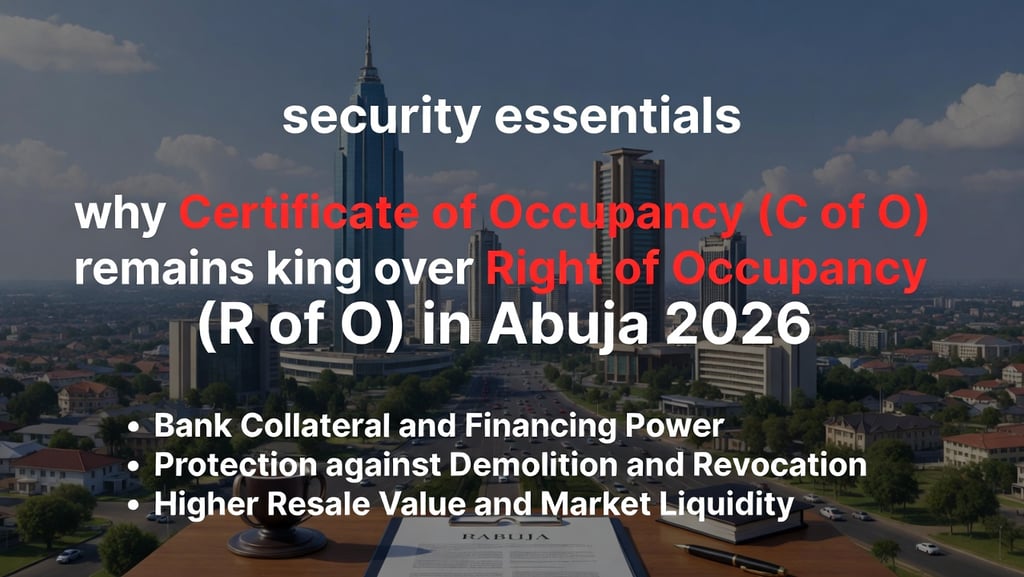

As land prices in Abuja continue to climb—especially in high-demand zones like Katampe, Guzape, Jabi, and Wuse II—the security of your title has never been more important. One wrong document can turn a ₦450 million investment into a nightmare of court battles, revoked titles, or outright demolition.
The two most common land documents in the FCT are:
Certificate of Occupancy (C of O) — the statutory land title issued by the Governor under the Land Use Act.
Right of Occupancy (R of O) — a preliminary grant, usually issued by the Minister or FCTA, pending full conversion to C of O.
While both give legal possession, they are not equal — especially in 2026’s stricter enforcement environment.
Why C of O Remains the Clear Winner
Bank Collateral & Financing Power
Commercial banks and mortgage institutions in Nigeria almost universally demand a C of O before approving any substantial loan or mortgage against a property.
R of O titles are frequently rejected or heavily discounted because they carry higher risk: the land can still be revoked if conditions (e.g., payment of fees, development timelines) are not met.
In practice:
C of O → 80–100% loan-to-value possible
R of O → 40–60% at best, if accepted at all
For buyers planning to leverage financing or refinance, C of O is non-negotiable.
Strongest Protection Against Demolition & Revocation
The FCTA’s aggressive revocation drive (over 6,000 titles cancelled in 2025 alone) has shown that R of O holders are far more vulnerable.
Under Section 28 of the Land Use Act, the Governor can revoke for non-compliance with terms — and R of O titles almost always contain more conditions (development timelines, ground rent payment schedules).
C of O, once issued, is considered a statutory grant with fewer revocation triggers, giving owners significantly stronger legal standing in court. Real-world example: In the 2025 River Park Estate saga, many affected allottees held only R of O or statutory allocations — making them easier targets for repossession compared to full C of O holders.
Higher Resale Value & Market Liquidity
Buyers and investors overwhelmingly prefer C of O properties.
Listings with C of O consistently sell faster and at higher prices (often 15–30% premium over R of O equivalents).
R of O properties frequently sit longer on the market or require deep discounts to attract buyers who understand the risk.
Easier Transfer & Inheritance
Transferring or bequeathing R of O titles often requires re-approval from the FCTA — adding time, cost, and uncertainty.
C of O transfers are more straightforward, usually requiring only consent fees and registration at the Lands Registry.
When R of O Can Still Make Sense
R of O is not worthless — it can be a legitimate stepping stone in certain cases:
Off-plan developments where the developer is actively pursuing C of O conversion.
Short-term investment plays (2–3 years) with clear exit plans.
Budget-conscious buyers in emerging areas where C of O is not yet widely available.
Even then, insist on:
Developer guarantee to deliver C of O within a fixed timeline.
Escrow or milestone-based payments.
Legal opinion confirming no revocation risk.
Practical Checklist for Buyers in 2026
Before signing any agreement:
Demand to see the original C of O (not photocopy).
Verify current status via the AGIS/FCTA portal (fctland.abj.gov.ng).
Confirm ground rent paid for last 3–5 years.
Ensure development has commenced if required (to avoid future revocation).
Engage a reputable lawyer to conduct full due diligence.
At House Unlimited Nigeria, every property we list comes with verified C of O (or ironclad path to one), paid dues, and no pending violations — giving you peace of mind in a market where title risk is rising.
Your next Abuja property deserves the strongest title possible.
→ Browse C of O-verified listings: houseunlimitednigeria.com/off-plan-properties
→ WhatsApp for free title verification: +234 904 375 2708
→ Book a consultation: official@houseunlimitednigeria.com
Don’t gamble with R of O when C of O is within reach.
House Unlimited Nigeria – Titles You Can Trust